



You asked for more tech. Here it is.



In our latest community survey, you made one thing pretty clear: more technical content.
Roger.
So this week, no long way round.
We’re talking Merak. Carbon, tube profiles, geometry, stability, stack, reach, T47 and UDH.
Get comfortable.
The new Merak frame weighs 700 grams. The fork, 280 grams.
Complete bike weight comes in between 6.9 and 7.1 kg, depending on the build.
Interesting numbers. But focusing on weight alone would only tell half the story.
During two years of development, we worked on what happens when speed starts to build.
That is why lightness was developed alongside stability.
The rear triangle and fork use more generous sections, adding structure and control exactly where we wanted them.

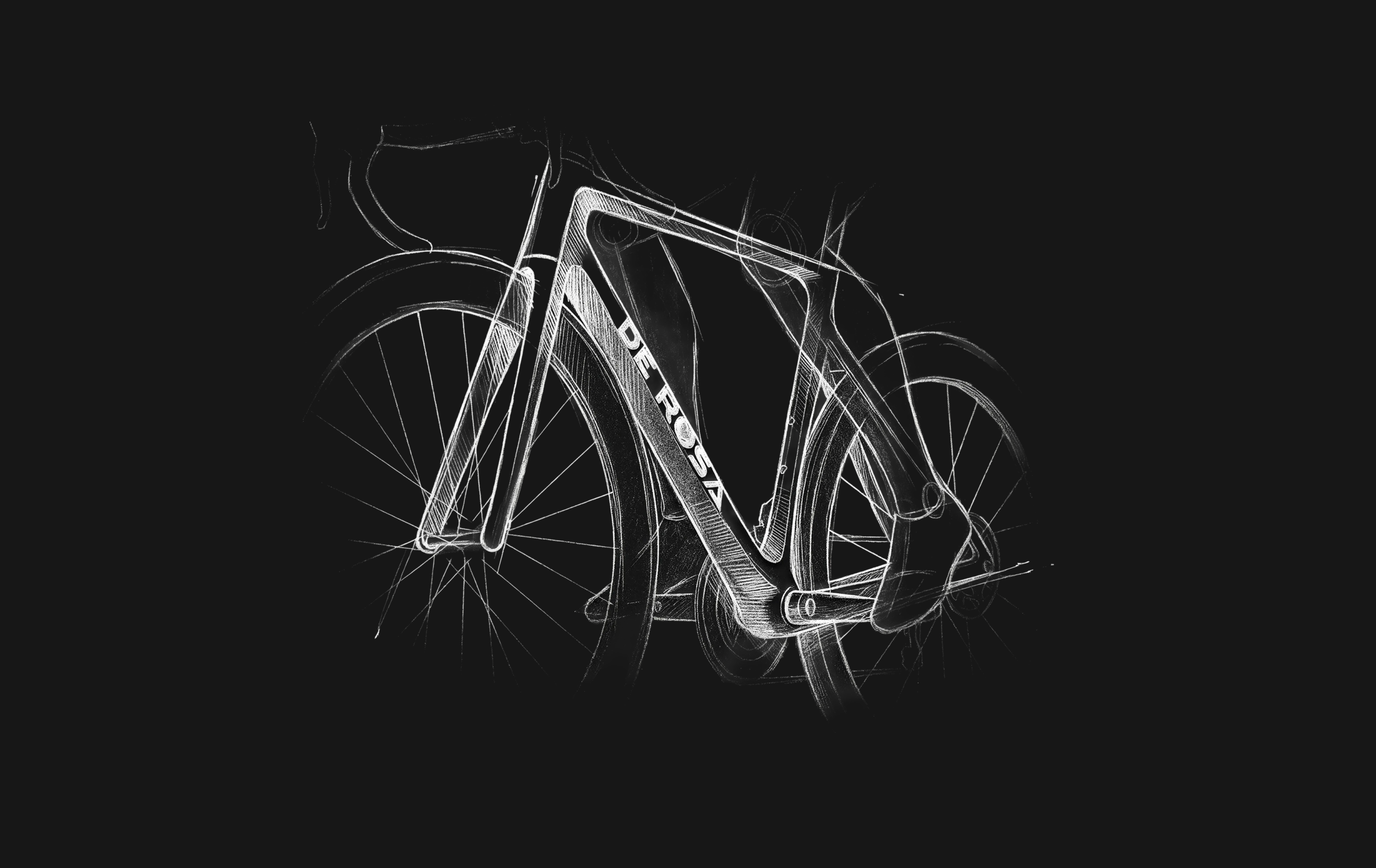
Look at Merak from the side and it is clean, taut, almost minimal.
The top tube flows continuously towards a compact front end. The lines feel stretched forward, with no unnecessary volume.
Then look at it from behind.
It changes.
The rear triangle and fork gain visual weight. Their sections become more pronounced, and the space around the wheel makes the frame architecture much easier to read.
Probably one of the most distinctive aspects of the new Merak: clean from the side, muscular from behind.

Eight sizes.
Merak is available in eight sizes, from 42.5 to 56.5.
Stack and reach progress across the range and, on a race-oriented bike, choosing the right size cannot simply come down to rider height.
A few numbers, since you asked:
Stack: 507 to 591 mm
Reach: 371 to 409 mm
Head angle: 70.7° to 73.4°
Chainstay length: 405 mm across the entire range
This is where bike fitting matters.
A lot.
And if you sit between two sizes, the advice is simple: less guesswork in front of a screen, more time talking to a De Rosa dealer or a professional bike fitter.

T47, UDH, 34c. We are officially in the nerd section now.
The bottom bracket is a T47, 85.5 mm.
The frame uses the UDH, Universal Derailleur Hanger standard.
Official tyre clearance is 34c.
The dedicated De Rosa seatpost comes with zero offset as standard, with 12 mm and 25 mm setback options also available.
That 34c clearance, in particular, gives you plenty of room to tune the setup: more tyre volume, more grip and more comfort than a more traditional racing configuration, without turning Merak into something it was never meant to be.
It is a lightweight all-round racing bike.
Built to climb, descend, accelerate, carry speed and handle different kinds of roads without forcing you to choose one speciality every time.

And then there’s the design.
We defined the visual language of the new Merak as retrofuturistic.
It looks back at its own history without copying it.
The logo gets smaller.
The frame surfaces become more important.
And, for the first time in many years, the De Rosa heart disappears from the head tube.
A small decision only on the surface.
The idea was to rely less on the symbol itself and more on proportions, design and the presence of the bike.
The heart hasn’t gone anywhere.
It simply no longer needs to be front and centre all the time.

Three aesthetic interpretations. One technical platform.
CLASSIC lets the geometry do most of the talking.
DYNAMIC uses longitudinal lines that run across the frame surfaces and seem to accelerate them.
RACE is the most direct, taut and explicitly competitive interpretation.
Different visual languages.
The same Merak underneath.
In the end, Merak is about balance.
Low weight without nervous handling.
Aerodynamics without turning it into a specialist aero bike.
Stiffness without losing control.
History without nostalgia.
Putting 700 grams on a spec sheet is easy.
The hard part was deciding how those 700 grams should behave when the road starts asking for more.
That is where we did the work.